Case 2: Berlin A
Name of project / programme:
Year of start / opening:
Country:
Target group:
Age:
City size:
Type of sport:
Sport im Park inklusiv – “Sport in the park inclusive”
2017 / 2023
Germany
people with disabilities, Social-economically disadvantaged
adults, seniors
more than 100.000 inhabitants
Exercises to enhance general fitness / health, Endurance sport, Playful movement, Ball games (e.g. soccer, basketball, volleyball….), Martial Arts / Combat sports, Dance / creative movement, Yoga / Tai Chi Chuan / Qi Gong
Content of project / programme
Short description:
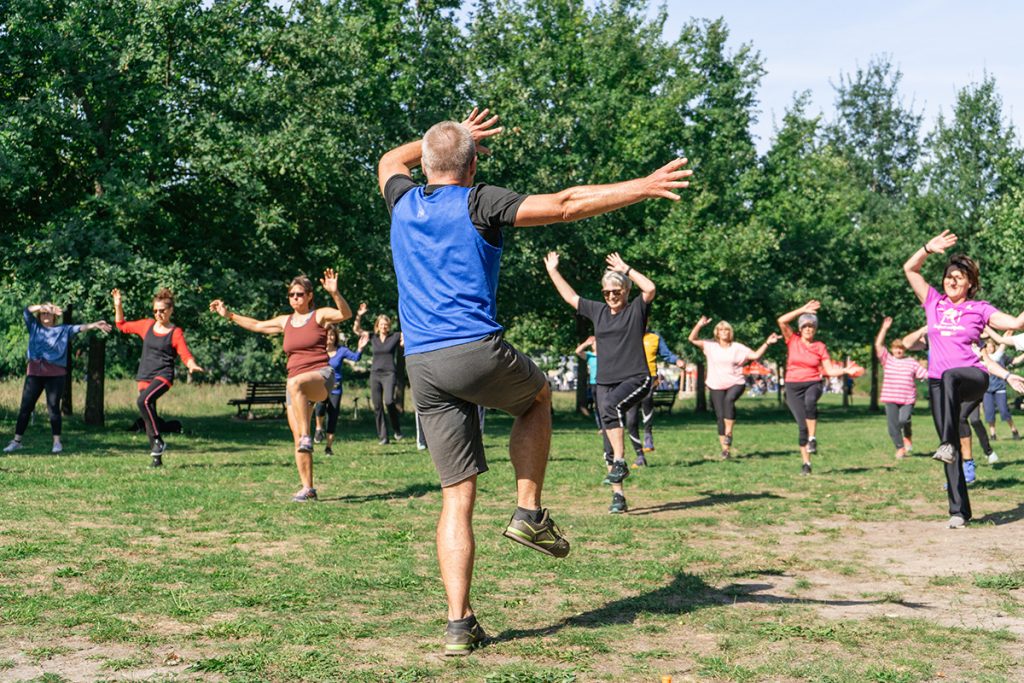
Sport im Park inclusive (“Sport in the park inclusive”) is a funding programme that enables sport clubs to offer training and exercises in the parks of Berlin. No registration or membership fee is necessary. Coaches are trained to adjust their training for people with (mental) disabilities.
Long description:
Sport in the park is organized and coordinated by the Senate Administration for the Interior and Sport of the county of Berlin. It is part of the county strategy “Berlin bewegt sich” (”Berlin in motion”) to enhance healthy movement which is run by the Senate Administration for Science, Health and Care. It is a funding programme allowing sport clubs of all kinds to apply in order to offer free-of-charge training sessions in the parks of Berlin. People can join the offer without being a member of a club and without a registration or long-term commitment. This way, the partaking is made very accessible. The range of sports depends on the different sport clubs involved. The courses run from May until October. Then, people have the opportunity to join the club as a member in order to continue the training indoors during the winter.
The programme had already been running for a couple of years when the Special Olympics World Games took place in Berlin in 2023. The city of Berlin as the organiser of this event was obliged to come up with a supporting programme alongside the Games. The staff of the Senate Administration ceased this opportunity to further develop their “Sport in the park” programme. In cooperation with the State Sport Association and the Sport Association for Disabled and Rehabilitation sport, they created a qualification programme for the coaches involved with Sport in the park. This qualification enabled them to adjust their training to the special needs that people with (intellectual) disabilities might have in order to join the training classes. Although the offers had been open to everybody and all skill levels beforehand as well, it now has become an essential part of the programme and its communication.
Additionally, the sport clubs benefit from the opportunity to gain new members.
Since the programme is tendered every year, the pool of sport clubs varies each year keeping a fairly constant number between 10-20 clubs. By now, it contains specialised, self-organised clubs such as a queer sport club or a sport club of the hearing impaired. It shows that the inclusiveness that is aimed for in the target group, is also displayed on a structural level. The programme enables sport clubs of all kinds – and therefore: people of all kinds – to gain visibility and maintain public space.
Aspects of good practice:
Sport in the park inclusive is considered a good practice, because…
…it motivates sport clubs to open up and cater for a new target group.
…it catalyses capacity building within the sport clubs.
…it shows a relatively high financial sustainability.
…staff of the Senate is engaged in creating network structures for knowledge sharing.
…has succeeded in involving target groups on a structural level.
…undergoes an annual evaluation process (organised internally).
Credit: SenInnSport