Case 7: Madrid
Name of project / programme:
Year of start / opening:
Country:
Target group:
Age:
City size:
Type of sport:
Dragones de Lavapiés
2014
Spain
ethnic minority, people with disabilities, Social-economically disadvantaged, LGBTQI+
youth, adults
more than 100.000 inhabitants
Ball games (e.g. soccer, basketball, volleyball….)
Content of project / programme
Short description:
Dragones de Lavapiés is much more than a football club: it is a social movement that uses sport to build community networks in one of Madrid’s most diverse neighborhoods. With over 600 players in 2025, its inclusive model (featuring mixed teams, LGBTQI+ squads, and no economic barriers) has transformed the pitch into a space where diversity is the norm.
Long description:
In Madrid’s multicultural heart, Dragones de Lavapiés has redefined what a sports club can be. What began in 2013 as an initiative by local families has become a national benchmark for inclusion through football. These families sought to create a space where their children could play without exclusion – a team that reflected their neighborhood’s diversity. Today, over 600 players demonstrate how sport can be a powerful tool for social transformation.
The Dragons’ model stands on three fundamental pillars. First, inclusion: no skill tests, affordable fees (with scholarships for 40% of participants), and teams like their “La Liga Gamberra squad” that showcase sexual diversity. Second, activism, embodied in campaigns like “Goal Against Racism” (2017) with international networks. Third, community integration, where football is just the starting point for activities like tutoring sessions or intercultural workshops.
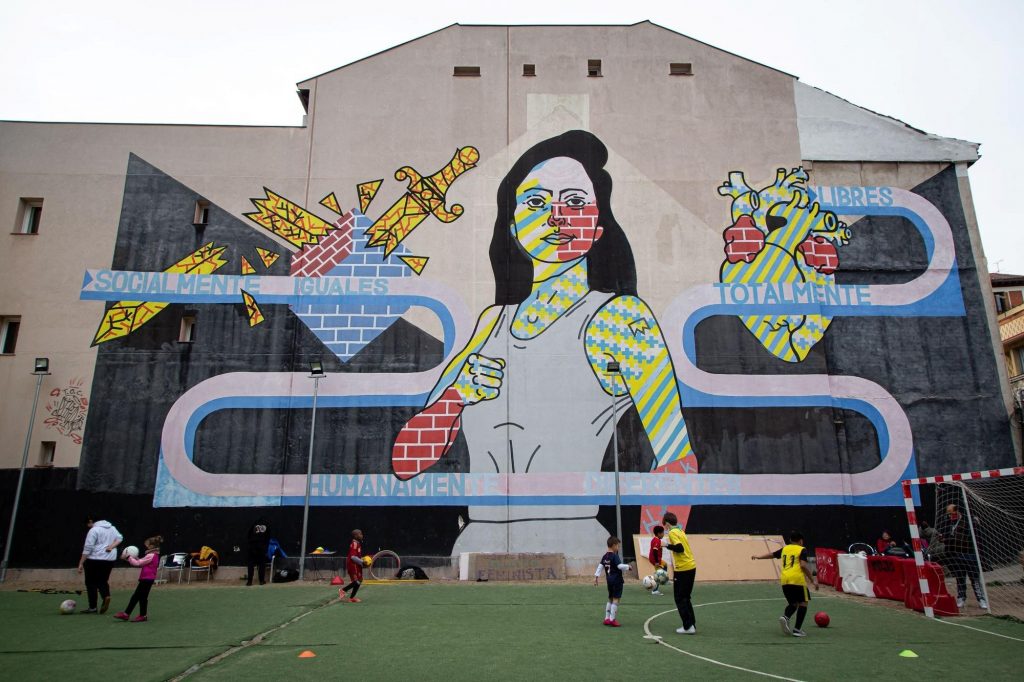
What makes this project special is not just its numbers, but how it has permeated the neighborhood’s identity. Their municipal training facilities have become social laboratories: parents organize solidarity snacks, business school students teach English, and women who had never touched a ball found in the graffiti “Socially equal, humanly different, completely free” an invitation to participate.
Their evolution since 2014 reflects this holistic approach. From initial children’s teams to mixed leagues (2016), then federated squads, and finally programs that transcend sport. This growth stems from participatory management where families, volunteers and players make joint decisions, plus strategic partnerships with organizations like FARE Network.
In 2025, the Dragons continue making history. What began as a few families’ dream is now a model proving how sport can build community. When Lavapiés children say “We’re a team against racism,” they’re not repeating a slogan – they’re living the essence of a project where every pass, every goal, and every post-match hug builds a fairer neighborhood.
Aspects of good practice:
- Participation of target group
- Meaningful involvement of target group
- Long-term participation
- High quality of collaboration / co-creation
- Good Communication
- Constant evaluation of project
- Capacity building internal
- Social activism
- Community integration
- Participatory management