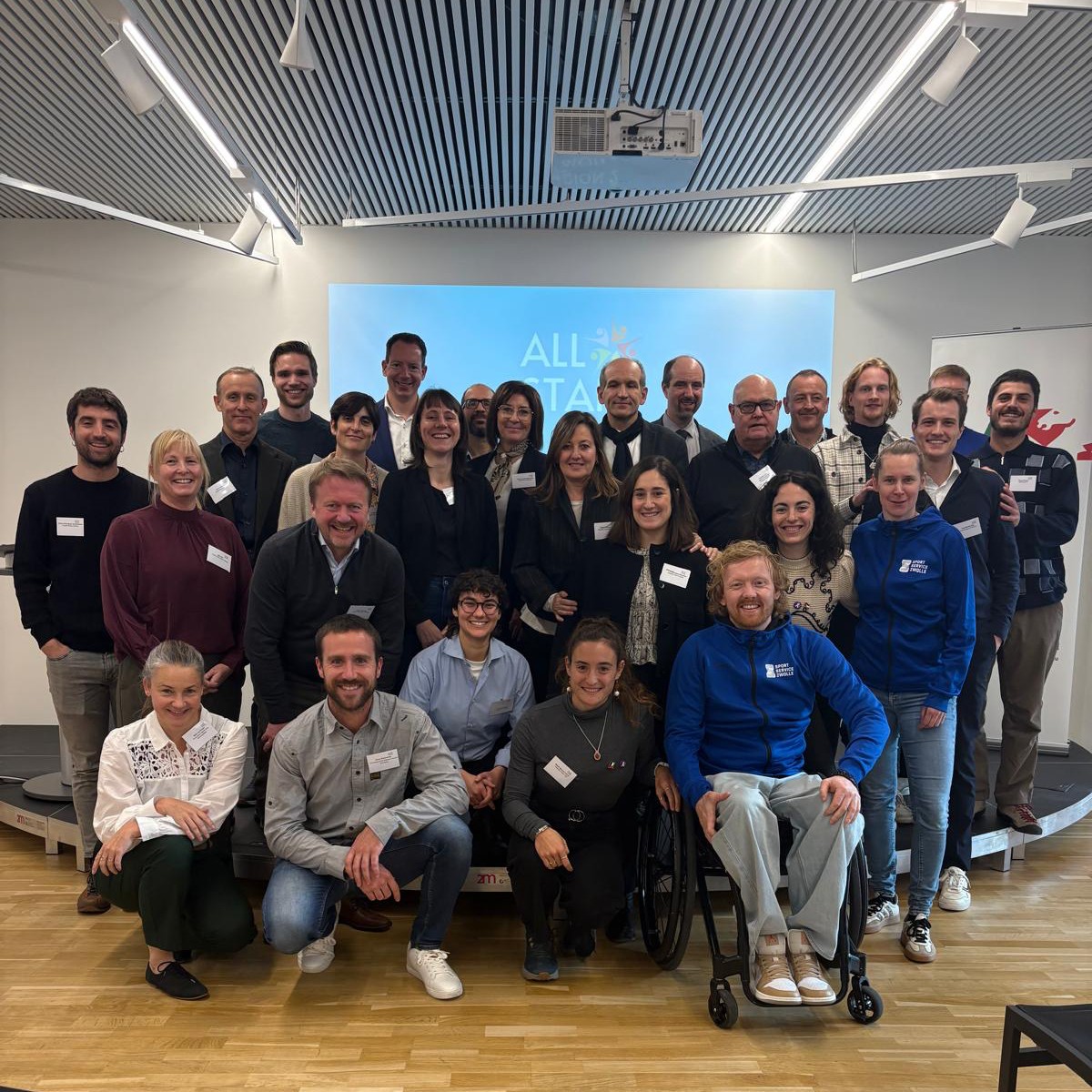
Held at the Representation of the State of North Rhine-Westphalia in Brussels on 21 November 2025, the ALLSTARS Conference brought together policymakers from across Europe to discuss how local networks can provide sport and physical activities for all.
The ALLSTARS project has focused on identifying and analysing successful local sport policies that promote inclusion and active lifestyles. Its objective has been to explore how local initiatives and governance structures can increase participation in sport. The final conference showcased the project’s findings, shared inspiring examples, and convened policymakers, sport organisations and community actors to discuss future opportunities for inclusive sport at the local level.
Opening Remarks
The conference opened with welcoming remarks from ENGSO Youth Chair Alessia De Iulis, who emphasised the importance of inclusion and ensuring access to sport for people from all walks of life.
First Session: Research Findings
The first session featured presentations from the research team behind the project “ALLSTARS – Good Practices for Active Lifestyles in Local Sports Policies.” Each participating country shared key findings such as the high relevance of socio-spatial orientation and the importance of cross-sector cooperation in promoting inclusion, accessibility and active lifestyles. The experts included:
- Germany
Jürgen Mittag, Till Müller-Schoell, Constanze Schulte – German Sport University Cologne - Spain
Irantzu Ibañez, Ekain Zubizarreta – University of the Basque Country, Leioa - Norway
Mari Eik, Oskar Solenes, Solveig Straume – Molde University College - The Netherlands
Nathan Geurink, Remco Hoekman – Mulier Instituut, Utrecht - Poland
Pawel Zembura – Fundacja Institute for Sport Governance (ISG), Warsaw
During an inspiring networking lunch break, participants had the chance to exchange experiences, ideas and gather more information on the good-practice-projects.
Following the networking lunch, an interactive session explored the question: “What do networks need from European institutions in terms of CONTEXTS, ACTORS and PROCESSES?” Participants were invited to share questions and remarks via a Mentimeter and vote on them – the statements with the most votes were taken over to the panel discussion in the third session of the event.
High-Level Panel Discussion
The conference concluded with a high-level panel moderated by Prof. Jürgen Mittag featuring expert guests:
Stanislas Frossard, Head of the Council of Europe’s Sport Division – Speaking from the Council of Europe angle, Mr. Frossard stressed:
- The relevance of the Revised European Sports Charter and its monitoring system, including annual implementation reports by member states.
- The importance of legally binding conventions, such as the Council of Europe Conventions, particularly regarding gender equality, safety, and integrity in sport.
- Reinforcement of sport as a social good, with benefits for health, equality and participation.
Hebe Schaillée, Professor, Sport & Society Research Group, Vrije Universiteit Brussel. Prof. Schaillée offered an academic and societal lens, highlighting:
- The shared values-based foundations of sport initiatives across sectors.
- The need to professionalise roles in grassroots sport, especially where volunteer reliance limits quality, continuity, and youth guidance.
- The importance of cross-sector collaboration between education, social services, and community structures.
- The challenge of re-integrating young people through sport after disengagement.
Katarzyna Biniaszczyk, Accredited Assistant to MEP Zdrojewski. Representing the European Parliament perspective, Ms. Biniaszczyk highlighted:
- The Parliament’s recently adopted report on the role of EU policies in shaping the European Sport Model, endorsed during the October plenary in Strasbourg.
- Strong commitment to defending and shaping the European Sport Model, including resistance to breakaway competitions.
- Recognition that professional sport cannot exist without a strong grassroots base, reinforcing the need for investment at the community level.
- A call for increased Erasmus+ Sport funding, noting that only 1.9% of the programme budget currently supports sport.
- Emphasis that sport must remain accessible to everyone, without exclusionary structures.
Iñaki Iturrioz, Head of the Sports Service of the Provincial Council of Gipuzkoa, Spain – Bringing a regional implementation perspective, Mr. Iturrioz emphasised:
- That decisions at the European level have direct consequences for local authorities responsible for delivery of sport.
- The need to move beyond serving only those already active and to intentionally include disadvantaged groups.
- The importance of creating entry opportunities and reducing structural barriers to participation.
- The relevance of the Global Action Plan for Physical Activity as a guiding tool for systematic, evidence-based change.
- The need to address the fragmentation of resources on the ground and better coordination and connectivity across programmes and actors.
The ALLSTARS Conference successfully highlighted how local initiatives can drive inclusion, foster active lifestyles, and strengthen the collaboration needed to make sport accessible for all.
About ALLSTARS project
ALLSTARS – Good practice For Active Life Styles in Local Sport Policies is an EU-funded research project that runs from 2024-2026. It is dedicated to describing and understanding inspiring sport projects and programmes that manage well in catering sport for all on a local level.
What kind of networks lead to a more inclusive sports practice?
Which common features can be depicted in otherwise very different projects?
How can municipalities contribute to sport and physical activities for people who are not or do not feel addressed by the regular sport club?
Which role do sport clubs play in this?
ALLSTARS aims at both, giving answers to these questions, as well as enabling people from sport organisations and municipal administration to get hands-on information, network opportunities and inspiration.