Author name: PolonaFonda

Spain

Case 8: Valencia

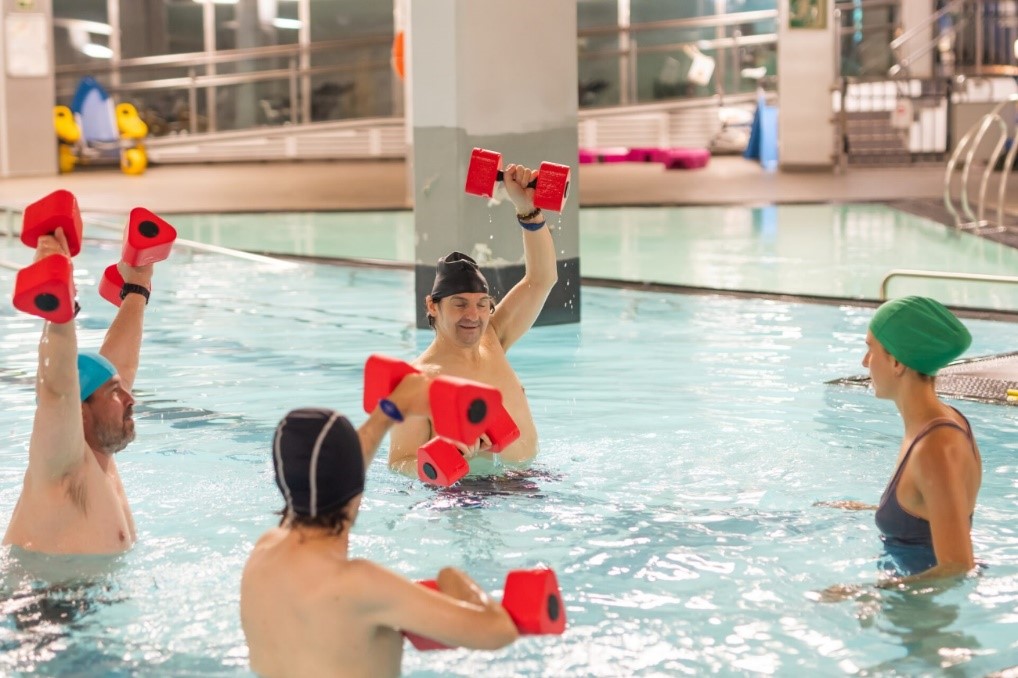
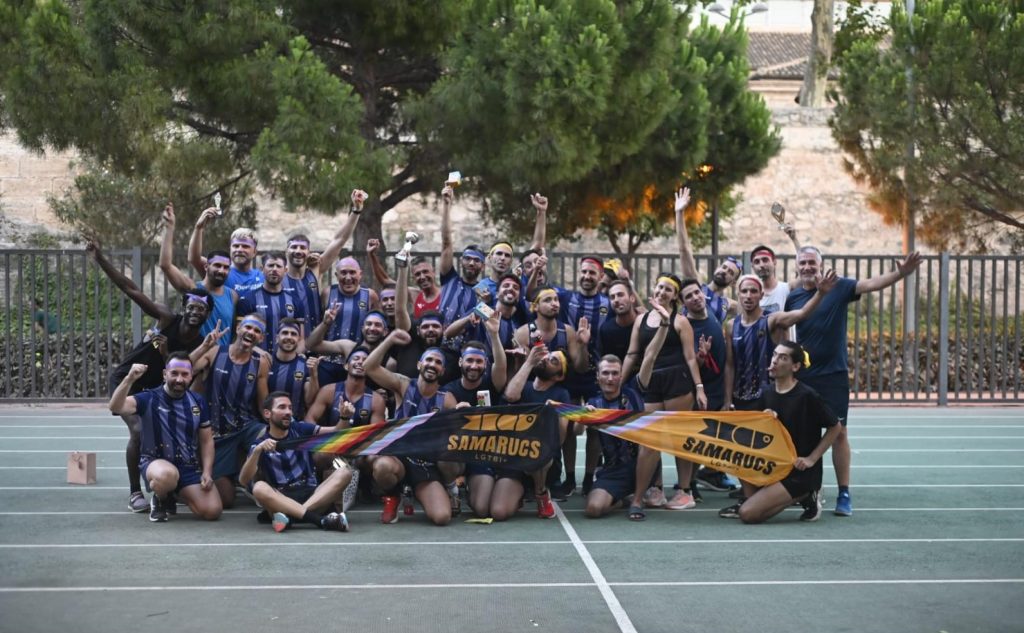
Case 8: Valencia Name of project / programme: Year of start / opening: Country: Target group: Age: City size: Type of sport: Club Deportivo LGTBI+ Samarucs 2003 Spain LGBTQI+ youth, adults more than 100.000 inhabitants Exercises to enhance general fitness / health, Endurance sport, Ball games (e.g. soccer, basketball, volleyball….), Martial Arts / Combat sports, Dance / creative movement, Yoga / Tai Chi Chuan / Qi Gong, Track and field, Water sports Content of project / programme Short description: Samarucs is an LGTBIQ+ sports club that began in 2003 and has grown to 630+ members offering 16 sports. It provides a safe, inclusive environment where sport becomes a tool for personal empowerment and social change. Beyond competitive teams, it fosters community through feminist leadership and programs like their Trans Youth Multisport initiative, transforming traditional sports spaces into welcoming environments for all identities. Long description: From its humble beginnings in 2003 as a small recreational sports group, Club Samarucs has grown into Spain’s benchmark for inclusive sport. What started as a safe space for LGTBIQ+ individuals to play sports without fear of rejection has become a thriving organization with over 630 members across 16 disciplines in 2025. Beyond the numbers, Samarucs represents something deeper – where physical activity transforms into powerful personal and collective empowerment. The club’s essence lies in creating genuinely safe environments that go beyond basic inclusion. As one member explains, “Here you can be who you truly are, without judgment.” This commitment extends beyond LGTBIQ+ specific issues, reflected in their sliding-scale membership fees ensuring no one is excluded due to financial limitations. At Samarucs, inclusion is not just a slogan but a daily practice. Samarucs has cultivated a unique dual identity as both a competitive sports club and community hub. It fields teams in federated leagues for swimming, athletics, volleyball and taekwondo – all proudly bearing LGTBI+ in their official names. Simultaneously, it serves as a social catalyst where sport drives broader change. While members clarify they are “not activists,” their visible presence in public sports facilities is quietly revolutionizing traditional athletic spaces. The club has consistently evolved through innovative programs like their 2021 Trans Youth Multisport initiative. Its gender-balanced leadership team (five women and five men) incorporates feminist perspectives into all operations. This inclusive approach permeates every detail – from communications to facility use – creating welcoming environments that have attracted even non-LGTBIQ+ participants seeking safer sporting spaces. Member testimonials reveal transformative impacts: “Samarucs is family,” shares one athlete. “Here I found myself,” confesses another. These stories illustrate how the club has surpassed its original sporting purpose to become a vital support network. With accessible fees starting at €5 monthly and strong community focus, Samarucs successfully blends athletic professionalism with activism. When Samarucs teams enter municipal sports centers wearing rainbow jerseys or row on the Turia River, they are not just playing sports – they are redefining what it means to belong. Each practice, each competition becomes an act of visibility and a step toward more inclusive communities, transforming historically hostile sports environments into spaces of acceptance and pride. Aspects of good practice: Participation of target group Meaningful involvement of target group Long-term participation Feminist gouvernance Strong co-ordinator retains overview of activities and people involved Good Communication Constant evaluation of project Sustainability Financial sustainability Clear goals, e.g. inclusion, empowerment, etc. Link to the website
Spain

Case 7: Madrid

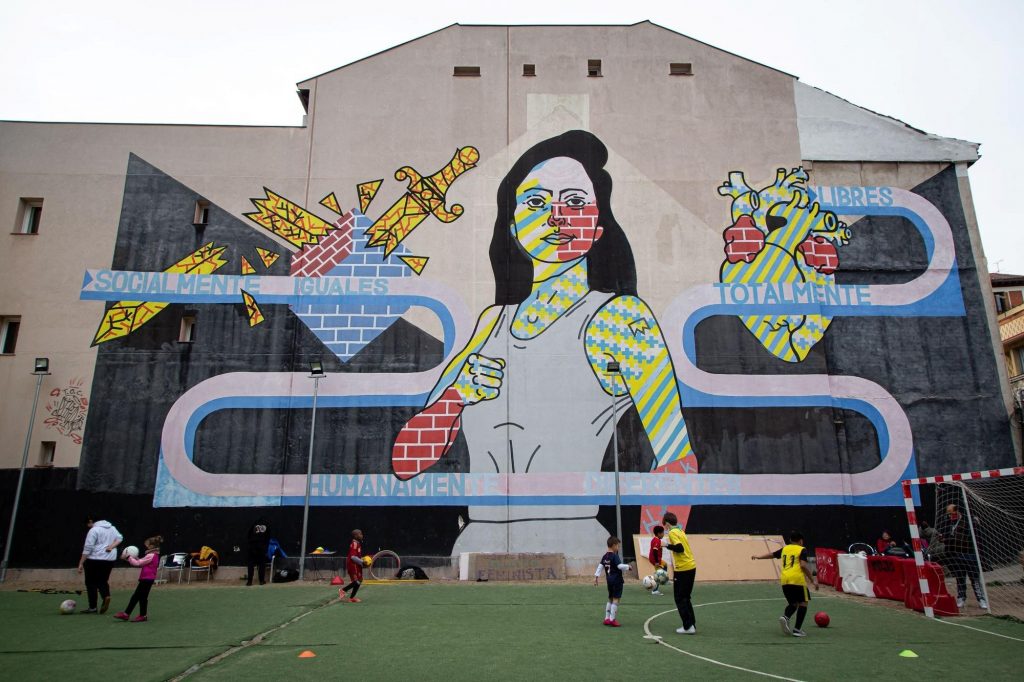
Case 7: Madrid Name of project / programme: Year of start / opening: Country: Target group: Age: City size: Type of sport: Dragones de Lavapiés 2014 Spain ethnic minority, people with disabilities, Social-economically disadvantaged, LGBTQI+ youth, adults more than 100.000 inhabitants Ball games (e.g. soccer, basketball, volleyball….) Content of project / programme Short description: Dragones de Lavapiés is much more than a football club: it is a social movement that uses sport to build community networks in one of Madrid’s most diverse neighborhoods. With over 600 players in 2025, its inclusive model (featuring mixed teams, LGBTQI+ squads, and no economic barriers) has transformed the pitch into a space where diversity is the norm. Long description: In Madrid’s multicultural heart, Dragones de Lavapiés has redefined what a sports club can be. What began in 2013 as an initiative by local families has become a national benchmark for inclusion through football. These families sought to create a space where their children could play without exclusion – a team that reflected their neighborhood’s diversity. Today, over 600 players demonstrate how sport can be a powerful tool for social transformation. The Dragons’ model stands on three fundamental pillars. First, inclusion: no skill tests, affordable fees (with scholarships for 40% of participants), and teams like their “La Liga Gamberra squad” that showcase sexual diversity. Second, activism, embodied in campaigns like “Goal Against Racism” (2017) with international networks. Third, community integration, where football is just the starting point for activities like tutoring sessions or intercultural workshops. What makes this project special is not just its numbers, but how it has permeated the neighborhood’s identity. Their municipal training facilities have become social laboratories: parents organize solidarity snacks, business school students teach English, and women who had never touched a ball found in the graffiti “Socially equal, humanly different, completely free” an invitation to participate. Their evolution since 2014 reflects this holistic approach. From initial children’s teams to mixed leagues (2016), then federated squads, and finally programs that transcend sport. This growth stems from participatory management where families, volunteers and players make joint decisions, plus strategic partnerships with organizations like FARE Network. In 2025, the Dragons continue making history. What began as a few families’ dream is now a model proving how sport can build community. When Lavapiés children say “We’re a team against racism,” they’re not repeating a slogan – they’re living the essence of a project where every pass, every goal, and every post-match hug builds a fairer neighborhood. Aspects of good practice: Participation of target group Meaningful involvement of target group Long-term participation High quality of collaboration / co-creation Good Communication Constant evaluation of project Capacity building internal Social activism Community integration Participatory management Link to the website

Spain

Case 6: Oarsoaldea (Lezo-Pasaia-Oiartzun)

Case 6: Oarsoaldea (Lezo-Pasaia-Oiartzun) Name of project / programme: Year of start / opening: Country: Target group: Age: City size: Type of sport: KOZ (Sport Orientation Service) 2013 Spain ethnic minority, people with disabilities, Social-economically disadvantaged youth, adults, seniors more than 30.000 and less than 100.000 inhabitants Exercises to enhance general fitness / health, Endurance sport, Playful movement, Ball games (e.g. soccer, basketball, volleyball….), Dance / creative movement, Yoga / Tai Chi Chuan / Qi Gong Content of project / programme Short description: KOZ (Sport Orientation Service) is an innovative public sports guidance service that, based on scientific evidence, has established a personalized public support system to transform physical activity into a sustainable habit. With a holistic approach (addressing physical, social and psychological aspects), it has successfully extended sports opportunities to inactive populations while gradually fostering behavioral change. The program not only increases participants’ engagement in physical activity but also improves their health and enhances social inclusion – particularly for individuals at risk of social exclusion or those experiencing partial/total isolation within their local communities. Long description: KOZ represents an innovative model in public sports policy, combining personalized guidance with scientific evidence to address physical inactivity at its social roots. Originally launched in Gipuzkoa (Basque Country) as a municipal initiative, this service has grown into an inter-community network prioritizing vulnerable and inactive populations: seniors, women, and those affected by socioeconomic disadvantages. The service operates through a referral system connecting health centers, municipal services, and communities. Healthcare providers, social services, or municipal offices refer inactive individuals or those with health risks to KOZ professionals, who then design customized physical activity programs with regular follow-ups. Participants may join KOZ-led group activities or be directed to local sports clubs, always with ongoing monitoring. Unlike traditional facility-centered approaches, KOZ’s qualified professionals serve as “physical activity prescribers,” working flexibly across various settings: municipal sports centers, healthcare clinics, community centers and public spaces. A scientific foundation supports the program, aligning with WHO’s Global Action Plan on Physical Activity (GAPPA) and using validated monitoring tools to track both participation and quality-of-life improvements. The approach emphasizes a preventive healthcare through exercise, safe socialization opportunities and community inclusion for all participants. Despite COVID-related challenges, KOZ’s collaborative funding model (combining municipal budgets, Provincial Council support, and Osakidetza healthcare system resources) maintains most activities free of charge, removing economic barriers. Since its 2013 pilot in Irun and expansion through the Basque Government’s 2016 Mugiment program, KOZ has achieved 33 active services across 23 municipalities (2024), 3,000 participants, with 30% becoming regularly active and sustainable operations through public institutional cooperation. This network continues evolving as a benchmark for community-based physical activation, proving that strategic partnerships and personalized approaches can successfully transform sedentary lifestyles into active, socially connected ones. Aspects of good practice: Long-term participation High quality of collaboration / co-creation Constant evaluation of project Financial sustainability Science-based policy and protocols Real inclusion Smart referral system Scalable model Community empowerment Link to the website Credit: Gipuzkoako Foru Aldundia

Spain

Case 5: San Sebastián

Case 5: San Sebastián Name of project / programme: Year of start / opening: Country: Target group: Age: City size: Type of sport: Hegalak 2012 Spain people with disabilities youth, adults, seniors more than 100.000 inhabitants Exercises to enhance general fitness / health Content of project / programme Short description: Hegalak is an inclusive sports center in San Sebastián that promotes physical activity adapted for all people, regardless of physical condition, disability, or socioeconomic status. Its unique strength lies in the synergy between the private management company, Kirola eta Gaitasuna, and the Fundación Hegalak Zabalik. The foundation funds adaptive and inclusive sports programs—such as pilot projects and essential services for highly dependent individuals—that are socially vital but not economically viable from a purely commercial standpoint. With individualized programs and a high-performance training service for athletes with disabilities, Hegalak offers an accessible space managed with an inclusive approach. It stands out for its AENOR certification (2015), which recognizes its comprehensive accessibility in both infrastructure and management. Currently, it serves 2,200 active users, including 300 in specialized health groups, and employs 38 specialized professionals. Long description: Hegalak is a pioneering inclusive sports project that has revolutionized the traditional concept of accessibility from its base in San Sebastián. The essence of its model lies in “reverse inclusion”: a space designed from the ground up for people with disabilities where, by design, everyone else fits perfectly too. In other words, it is a sports center with universal design, created for all people to use, with or without disabilities. This groundbreaking philosophy has created a unique environment where coexistence between people with and without disabilities becomes completely natural. A cornerstone of Hegalak’s success and sustainability is the effective synergy between the private company that manages the center, Kirola eta Gaitasuna, and the Fundación Hegalak Zabalik. This partnership allows Hegalak to operate programs that would otherwise be unsustainable. The foundation finances adaptive and inclusive sports initiatives, which often include pilot projects that are later adopted by the management company once their viability is proven, as well as essential programs—like physical activity for highly dependent individuals—that are socially necessary but not economically profitable on their own. This model ensures that both innovative and critical services can be offered long-term. The center places health at the heart of its approach. Movement becomes therapy: from functional rehabilitation programs to activities that improve mental health, all supported by a multidisciplinary team of 38 professionals (doctors, physiotherapists, coaches). The public-private sponsorship system and collaboration with public entities like Osakidetza have enabled the creation of specialized health groups serving 300 participants. A key milestone was obtaining the AENOR universal accessibility certification in 2015, becoming the first sports center in Spain certified for both infrastructure (universal design in doors, flooring, and signage) and management. This recognition strengthens its personalized care model, which ranges from inclusive classes across various disciplines to high-performance training programs for Paralympic athletes. Hegalak’s impact multiplies through its network collaboration with public entities (Osakidetza, Provincial Council), sports federations, and private companies. It functions as a reference hub: when other municipalities cannot address specific cases, users follow personalized programs at the center before returning to their communities with greater autonomy. This synergy, combined with active communication (media campaigns, social media), has been crucial for disability visibility. With 2,200 active users and near-full capacity, the project has exceeded all expectations. Its success stems not only from the aforementioned aspects but also from the balance between technical innovation (cutting-edge, well-located facilities) and human warmth/quality, sustained by a mixed economic model (public subsidies and private sponsorships). More than a sports center, Hegalak is a catalyst for social change where sport becomes a tool for health, authentic inclusion, and community transformation. Aspects of good practice: Participation of target group and real inclusion Meaningful involvement of target group Long-term participation High quality of collaboration / co-creation Sharing knowledge Constant evaluation of project Sustainability Financial sustainability Clear goals, e.g. inclusion, empowerment, etc. Internal and external capacity building Individualized adaptation Health-focused approach Inclusive infrastructure and management   Link to the website Credit: Leintz Eskola Kirola

Spain

Case 4: Leintz Valley

Case 4: Leintz Valley Name of project / programme: Year of start / opening: Country: Target group: Age: City size: Type of sport: Leintz Eskola Kirol Egokitua (LEKE) 2018 Spain people with disabilities youth, children more than 30.000 and less than 100.000 inhabitants Playful movement, Water sports Content of project / programme Short description: LEKE is an adapted extracurricular sports program for children and youth aged 6 to 21 that offers adapted physical activities using school and municipal facilities. The program stands out for its attention to the specific needs and contexts of participants, promoting pedagogical coherence through integration with school activities and involving the entire educational community. It encourages inclusion by allowing children to participate in both adapted (EKE) and inclusive (EKI) sports programs based on their abilities, fostering shared experiences and learning through diversity. LEKE also extends its impact beyond the school by engaging local entities and families, building community ties and social cohesion. The initiative is marked by strong coordination among educators, families, and professionals, ongoing support from the Guipuzcoa Federation of Adapted Sports, and the dedicated involvement of staff, ensuring quality, adaptability, and long-term sustainability. Long description: LEKE is an adapted extracurricular sports program for boys and girls between the ages of 6 and 21 where they perform different physical activities, both in the gym and in the swimming pool, twice a week and some weekends, using school and municipal facilities. There are several characteristics that make LEKE an inspiring practice. On the one hand, the project has been designed considering the peculiarities, needs, abilities and specific contexts of the children. The initiative promotes a recreational and adapted sports practice that is part of the official Extracurricular Sports program organized by the respective Provincial Council and is articulated with the school’s own activities, which guarantees pedagogical coherence, continuity and active participation of the students. Thus, the educational center assumes an active role, integrating the initiative in its Educational Project of Center (PEC) and involving the entire educational community (teachers, management, families) in the daily accompaniment of the children, as well as in the activities. The project also offers a mixed offer in which children who participate in the adapted extracurricular sports program (EKE) can also participate in the inclusive extracurricular sports program (EKI) and vice versa, according to their needs and abilities. This bridge or link between the two programs generates more shared spaces where all children can coexist, participate and learn together from diversity. On the other hand, beyond the school environment, the initiative is open to the community, fostering links with local entities, families and public spaces. It promotes a collaborative network that strengthens the social fabric and reinforces the sense of belonging. In addition, the team maintains constant, direct and empathetic communication with families and students, generating trust, closeness and a positive experience for all participants. The project is based on solid planning and permanent coordination between the different actors (center, families, monitors, federation), which ensures a smooth implementation and a quick response to any need. It is also important to highlight the advice of the Guipuzcoa Federation of Adapted Sports, which technically accompanies the project, offering training, materials, follow-up and institutional leadership. This support guarantees quality, continuity and long-term projection. Finally, it is important to highlight the involvement of the staff (monitors, teachers, coordinators) who participate with a high degree of awareness, motivation, commitment and autonomy, which translates into a lively, flexible proposal adapted to the realities of the children. Aspects of good practice: Adapted to the peculiarities and needs of the children Integrated offer within the general offer of Extracurricular Sport Involvement of the school in the day to day (within the Educational Project of the Center) Mixed offer and bridge link between the program of adapted extracurricular sport (EKE) and inclusive extracurricular sport(EKI) Community project Close contact with families Strong coordination and structure Advice and leadership of the Adapted Sport Federation Awareness, involvement and freedom of workers Link to the website Credit: Leintz Eskola Kirola

Spain

Case 3: San Cristóbal de La Laguna

Case 3: San Cristóbal de La Laguna Name of project / programme: Year of start / opening: Country: Target group: Age: City size: Type of sport: Campus Sansofé 2021 Spain refugees, social-economically disadvantaged youth, adults more than 100.000 inhabitants Ball games (e.g. soccer, basketball, volleyball….), Track and field Content of project / programme Short description: Campus Sansofé is an inclusive sports project that uses soccer, basketball, and track and field to support the integration of young migrants—primarily boys—into the local community. Born from the expressed needs of migrants themselves, it fosters their active participation and visibility as valuable community members. The initiative promotes mutual learning, solidarity, and empathy among participants, including volunteers and local residents, creating strong social ties and a supportive network involving community members, organizations, and institutions. With a flexible and spontaneous structure, it encourages diverse, voluntary contributions and aims to counteract negative narratives about migration by promoting a more positive and humanizing view through community engagement. Long description: Campus Sansofé is a project that understands the practice of sports as a tool for inclusion in the local community. The initiative offers soccer, basketball and track and field training and friendly matches with local clubs to migrants, mostly young boys. There are several characteristics that make Campus Sansofé an inspiring practice. On the one hand, the project was born as a direct response to the concerns and needs expressed by young migrants who demanded participation in soccer and later in other sports. The project contributes to making visible and normalize the presence of migrants as an active and enriching part of the community. Thus, real and effective inclusion is guaranteed through the active participation of migrants. On the other hand, the experience of getting involved in activities in support of the migrant community becomes a process of personal transformation for those who participate. It generates mutual learning that strengthens social ties and fosters values such as solidarity, justice and empathy. In this way, it promotes the creation of a community support network that links neighbors, social organizations, educational institutions and volunteers, favoring a coordinated and sustainable response to the needs of this group. The initiative is characterized by its flexibility and dynamism: there is no rigid structure, but it is based on spontaneous and voluntary participation. Each person contributes from his or her knowledge, time and possibilities, generating a diverse and supportive community. One of the project’s main priorities is to counteract the negative discourse on migration promoted by some media. Through community meetings, a more humane, complex and positive reality about migrant experiences is shown. Aspects of good practice: Response to a real demand from young people Normalization of the presence of migrants in society Real and effective inclusion Personal/social enrichment by giving help Social involvement and support network for the migrant collective Spontaneous organization, each person contributes what he/she can Dissemination to make known another reality different from that of the media Link to the website Credit: Campus Sansofé

Spain

Case 2: Barcelona II

Case 2: Barcelona II Name of project / programme: Year of start / opening: Country: Target group: Age: City size: Type of sport: Criquet Jove a BCN 2012 Norway ethnic minority children, youth more than 100.000 inhabitants Other: Criquet Content of project / programme Short description: Criquet Jove a BCN is an intercultural and socio-educational project in Barcelona that uses cricket as a means of social transformation and empowerment for youth aged 8 to 23, particularly from the South Asian community. By offering free extracurricular cricket activities in public spaces, the initiative fosters cultural inclusion, gender equity, and dialogue between communities, helping to combat stigma and promote positive role models. It also supports the professionalization of cricket through training and competitions, creating opportunities for personal and career development. The project is sustained by a diverse network of social, educational, and community partnerships, along with a flexible funding model and ongoing impact evaluation, ensuring its adaptability, inclusiveness, and long-term sustainability. Long description: Criquet Jove a BCN is an intercultural and socio-educational project that understands the practice of cricket as a tool for social transformation and empowerment. This initiative offers the practice of cricket through extracurricular activities in public spaces in different neighborhoods of Barcelona and is aimed at children from 8 years old to 23 years old. There are several characteristics that make Criquet Jove a BCN an inspiring practice. On the one hand, the project arises as a response to a specific need of the South Asian community to have sports spaces where to practice cricket, a sport with a strong identity for the community. Thus, it incorporates an intercultural vision that recognizes, respects and values the ethnic and cultural diversity of the participants. At the same time, gender equity is guaranteed through the active inclusion of girls and women. The project acts as a catalyst for social change, generating visibility for minority groups and encouraging dialogue between cultures, transforming stigmatizing perceptions and promoting new positive references for the community, especially for young people. It also promotes the professionalization of cricket through training, formal competitions and institutional recognition. This opens up opportunities for sports and job development for the participants. All activities are carried out free of charge and in public or community spaces, eliminating economic and geographic barriers to ensure full and diverse participation. On the other hand, the project is based on a network of collaboration between sports, social, educational and community actors, generating an integral approach that improves the impact of the actions. In addition, the project has an adaptable financing scheme combining public funds, private support and community resources, ensuring sustainability and autonomy in project management. The initiative also implements a continuous evaluation system that allows for adjusting actions in real time, measuring impact and gathering lessons learned for future improvements. Through dissemination campaigns, articulation with the media and presence in events, it seeks to promote and integrate cricket in the host society. Aspects of good practice: Response to a real demand (identity sport) Intercultural and gender perspective Social impact (visibility, transformation, dialogue tool, creation of references) Sport impact (professionalization) Accessibility (free, public spaces) Coordination and interdisciplinary networking (sport and social) Flexible financing Continuous evaluation (monitoring of activities, constant review) Promotion and standardization Link to the website Credit: Street Soccer Barcelona

Spain

Case 1: Barcelona 1

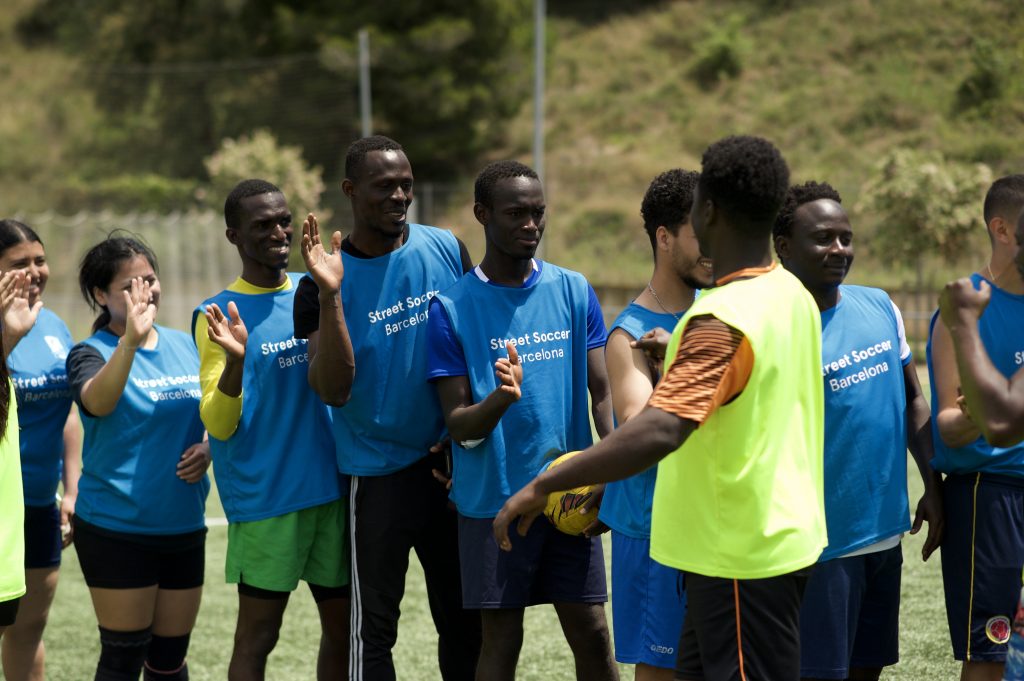
Case 1: Barcelona 1 Name of project / programme: Year of start / opening: Country: Target group: Age: City size: Type of sport: Street Soccer Barcelona 2018 Norway refugees, Social-economically disadvantaged youth, adults more than 100.000 inhabitants Ball games (e.g. soccer, basketball, volleyball….) Content of project / programme Short description: Street Soccer Barcelona is an association that uses soccer as a tool to foster social inclusion, empower youth, and promote community cohesion. Since 2018, it has been creating open and safe spaces for people in vulnerable situations, particularly young migrants, refugees, and the homeless. With a rights-based approach, the organization transforms sport into a powerful driver of social change, encouraging coexistence and dialogue within Barcelona’s neighborhoods. Through open sessions, organized teams, and soccer camps on public fields throughout the city, the program offers flexible and accessible participation. It also provides a safe, supportive environment that helps build positive social connections and promotes healthy habits through regular physical activity, access to showers, and daily snacks. Participants receive ongoing support from social organizations, ensuring personalized care, while community outreach efforts foster integration and mutual understanding. The program’s success is further strengthened by collaborations with social entities, the dedication of volunteers, and sustainable funding from institutional partners. Long description: Street Soccer Barcelona is an inclusive project that understands the practice of soccer as a tool for integration into the local community. It is aimed at a group at risk of social exclusion, especially young migrant children and adults. The initiative is based on soccer open sessions, soccer teams and soccer campuses/colonies that take place in different public soccer fields in Barcelona. Several characteristics make Street Soccer an inspiring practice. On the one hand, considering that soccer is a globally recognized and valued sport, Street Soccer is an attractive and universal practice that attracts the participation of different people, especially young migrant boys. The program is designed to adapt to different realities and needs, and its ease and flexibility of access to practice is interesting for users as they can come and go without any commitment according to their needs. In addition, this initiative provides a safe and stable space where participants have the opportunity to create positive references and bonds for their well-being and integration. In addition, the regular practice of sports and the opportunity to shower and have a snack daily offer participants an opportunity to improve their healthy habits. On the other hand, there is continuous monitoring of the participants by the different social entities, which allows them to adapt and attend to the individual needs of each person. The program also incorporates awareness-raising actions aimed at the local community, which promote mutual understanding and the collective commitment of the host society to the integration of the participants. There is a close relationship with different social entities that refer users, which reinforces the support network and increases the effectiveness and scope of the program. The commitment of the volunteers is also a fundamental pillar in the development of the initiative, as well as the economic sustainability offered by the different institutions through their financing. Aspects of good practice: Attractive and universal practice Accessibility and flexibility Safe and stable environment Promotion of healthy habits Personalized follow-up Co-responsibility of the host society Coordination with collaborating entities Volunteer commitment Economic sustainability Link to the website Credit: Street Soccer Barcelona

Poland

Case 6: Głogów

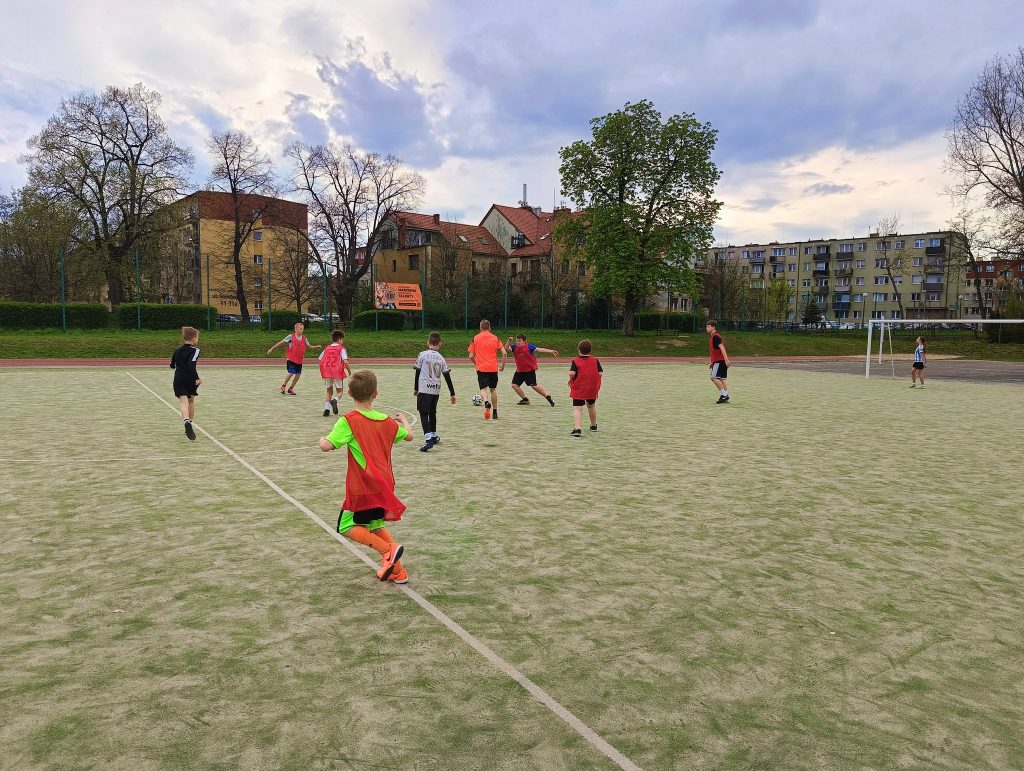
Case 6: Głogów Name of project / programme: Year of start / opening: Country: Target group: Age: City size: Type of sport: Trener Osiedlowy (Neighbourhood Coach) 2019 Poland Children and adolescents from urban neighbourhoods, with a focus on areas with limited access to organised sports Children and adolescents (approx. 6–16 years old) more than 100.000 inhabitants Ball games (primarily football), general physical activities Content of project / programme Short description: The ‘Trener Osiedlowy’ project is a sport-based social initiative run by Chrobry Głogów S.A., a professional football club. It delivers free, locally accessible physical activity sessions for children and young people in selected neighbourhoods of Głogów, in cooperation with local schools and the city authorities Long description: The ‘Trener Osiedlowy’ programme has been implemented in Głogów since 2019. It is coordinated by the football club Chrobry Głogów S.A., in cooperation with the City of Głogów and local partner institutions such as schools and the NGO Stowarzyszenie Szansa. The aim is to promote physical activity and support social development of children and adolescents, particularly those who are not involved in organised sport structures. The programme is based on regular, free-of-charge sports sessions delivered in accessible locations—mainly school playgrounds and local sports fields. In 2023, the initiative reached over 300 children across multiple neighbourhoods. Activities are conducted by licensed coaches employed by the club and additionally trained in child safeguarding practices. The programme is fully financed by the City of Głogów. In 2024, the municipal budget allocated 110,000 PLN (~€25,000) to the project. The funds cover coach remuneration, equipment, and coordination. In-kind support is provided by schools and other local institutions, which allow the use of facilities and help with participant recruitment. Monitoring and evaluation are conducted informally through coach reports and stakeholder feedback. Interviews conducted with school representatives and municipal officials confirm that the initiative has improved physical activity levels among children and fostered cooperation between education and sport sectors. A key element of the initiative’s success is the long-standing relationship between the club and local authorities. The programme remains relatively small in scale and operates without permanent infrastructure or strategic evaluation. Its continuity depends on annual public funding decisions and engagement of coaches and local partners. Aspects of good practice: This practice is considered a good example due to:– Its long-term and institutionalised partnership between a professional football club and local authorities– Use of existing public infrastructure with minimal investment needs– Specific focus on local community needs and children not engaged in mainstream sport– Regular delivery of sessions and sustained contact with participants– Inclusion of safeguarding and child development components in coach training Link to the website

Poland

Case 5: Nationwide – V4Sport Foundation

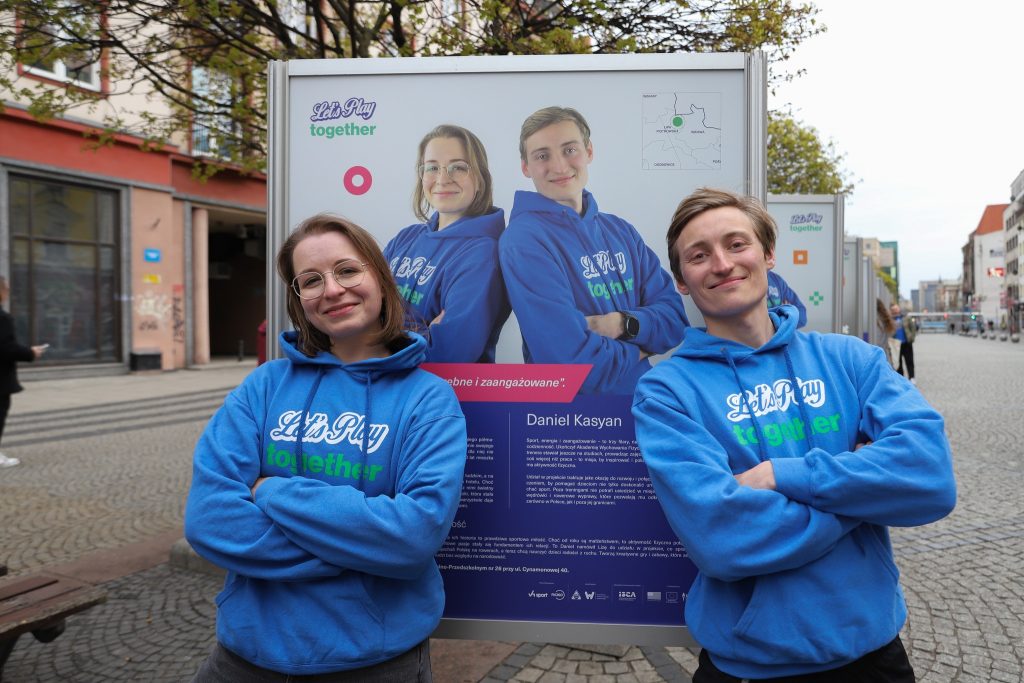
Case 5: Nationwide – V4Sport Foundation Name of project / programme: Year of start / opening: Country: Target group: Age: City size: Type of sport: Let’s Play Together 2024 Poland Children and young people, including those with disabilities, from migrant (Ukraine) backgrounds, and experiencing social or economic disadvantage as well as Polish children and young people Children and adolescents more than 100.000 inhabitants ((project implemented in urban and semi-urban locations)) Multi-sport, inclusive games, adapted physical activity Content of project / programme Short description: Let’s Play Together is an inclusive sport programme coordinated by the V4Sport Foundation. It creates accessible and safe environments where children and young people from diverse backgrounds can engage in physical activity together. The initiative includes sport festivals, school-based programmes, and community workshops focused on social integration through play. Long description: Let’s Play Together is an initiative launched in 2024 by the V4Sport Foundation, a Polish NGO with longstanding experience in designing and scaling innovative approaches to sport-based inclusion. Building on the Foundation’s earlier work—including the ‘Activity for All’ model, ‘Open Playgrounds’, and partnerships with international organisations like TAFISA and EOSE—the programme aims to improve integration of socially excluded children through non-competitive, inclusive sport and play. The programme is implemented in collaboration with schools, municipalities, and local NGOs. Its activities include inclusive sport events, open play sessions, and capacity-building workshops for teachers and coaches. One of its core components is co-designing activities with children, ensuring that their voices are reflected in how sport sessions are structured. Let’s Play Together is part of a broader commitment by V4Sport to promote equity, diversity, and inclusion in the Polish sport sector. Its methodology builds on universal design principles and draws from successful models piloted in previous Erasmus+ and national projects. The initiative uses publicly accessible spaces, such as schoolyards and parks, and involves local actors in sustaining long-term engagement. Funding is sourced from international cooperation projects. The initiative is monitored through participatory evaluation tools, including feedback from children, teachers, and community facilitators. Aspects of good practice: This practice is considered a good example due to:– Its continuity with previous inclusive sport models developed by V4Sport;– Its application of universal design and co-creation approaches;– Its focus on local partnerships with schools and NGOs;– Its combination of sport delivery with educational and community engagement strategies;– Its sustainability approach through institutional partnerships and multi-source funding. Link to the website

Scroll to Top